
Plenty of charities do work that resists a tidy number. You help someone feel less alone, more confident, more in control of their life, more hopeful. These are soft outcomes: changes in how people feel, what they believe they can do and who they have around them, as distinct from hard outcomes such as a job, a qualification or a place to live. Soft doesn’t mean less important. Often the soft change comes first and makes the hard one possible, because it takes confidence to apply for a course and trust to keep coming back.
Then a funder asks you to “measure your outcomes”, and it can feel as though they’re asking you to put a figure on something that was never a figure in the first place. If that’s you, you can almost certainly evidence the change you make, and you probably already have most of what you need. The problem is usually a misunderstanding of what “measure” means.
Measuring doesn’t mean counting
The word “measure” makes people picture spreadsheets and statistics. But to a funder, measuring your impact simply means being able to show that change happened, and being honest about how you know. A number is one kind of evidence. It is not the only kind, and for relational work it is often not the best kind.
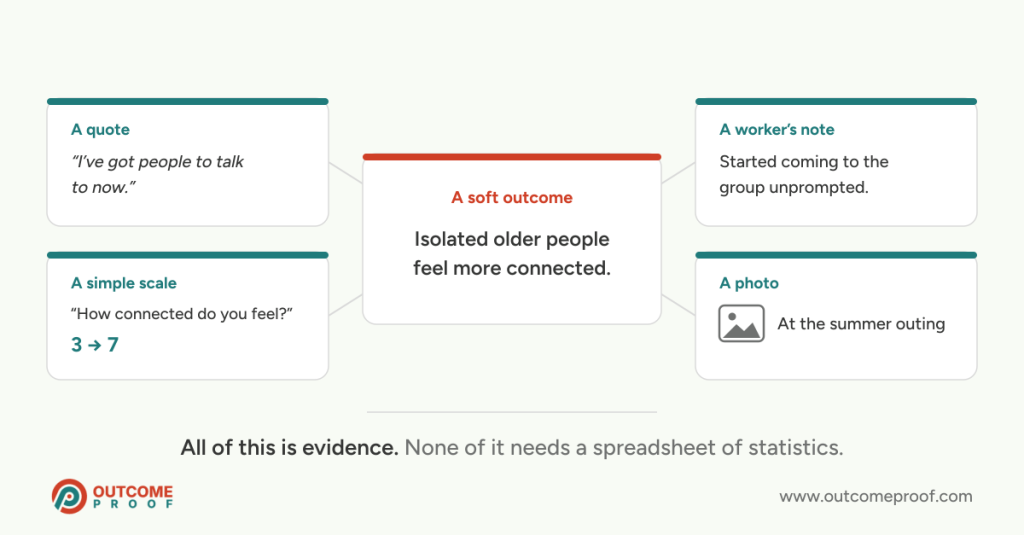
When someone tells you the group is the only place they feel like themselves, that is evidence. When a support worker notes that a young person who never spoke up has started leading the session, that is evidence. When a parent’s shoulders visibly drop because someone finally listened, and you write that down, that is evidence. None of it is a percentage, and all of it shows real change.
So the task isn’t to force your work into numbers. It’s to notice the change you already see and hear every week, and to capture it before it’s forgotten.
What funders actually want to see
Most funders of small charities aren’t asking for statistical proof. What they want to know is that the change is real, that it connects to what they funded, and what makes you confident it happened. Numbers and stories each do part of that: a count shows how far the change reached, and a person’s own words show what it meant. For work that changes lives quietly, the strongest evidence usually puts the two side by side, and one believable story can carry more weight than a page of bare figures. Honest and specific beats impressive and vague every time.
What counts as evidence when the change is a feeling or a relationship
Here’s the fuller toolkit, none of which requires a research background:
- Quotes and stories. The words of the people you work with, in their own voice. One good quote can carry a whole outcome.
- Your own observations. A short note from a worker or volunteer who saw the change happen. Written down soon after, these are genuine evidence, not just anecdote.
- Simple scales. Ask people to rate something before and after, even loosely: “On a scale of one to ten, how confident do you feel about managing your money?” The shift from a three to a seven is a number, and it came from a feeling.
- Small counts that stand in for change. Someone attending regularly when they used to drop out, volunteering for something they’d have avoided, coming back the following term. Behaviour is evidence of how someone feels.
- Photos. An image of someone doing something they couldn’t or wouldn’t have done before, saved with a line about why it matters.
- What others notice. A teacher, a GP, a family member remarking on the difference. Third-party observations are especially credible.
Mix a couple of these for each outcome and you have something far stronger, and far more human, than a lone statistic.
Distance travelled: measure the journey, not just the finish line
The most useful idea for “hard to measure” work is distance travelled. A lot of change is about someone moving forward, even if they haven’t arrived. A person managing their anxiety enough to leave the house is a real outcome, even if they’re not yet holding down a job. Measuring distance travelled just means noticing where someone started, and where they are now.
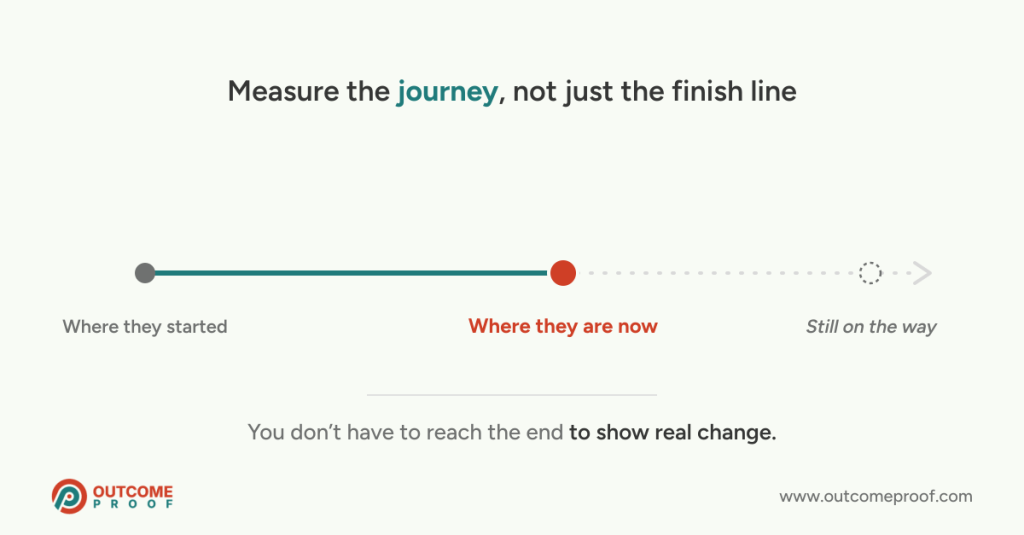
You can capture it lightly: a simple check-in at the start and again later, a worker’s sense of how far someone has come, a person’s own account of what’s changed for them. It lets you show progress honestly without pretending everyone reaches a neat endpoint, and it respects the reality that with the people many small charities support, moving forward at all is the achievement.
Two things make it more convincing in a report. Ask everyone the same question in the same way, so you can give a count with its total: “11 of the 15 members we asked feel more connected than when they joined” is easier for a funder to weigh than one person’s story alone, and the story then shows what the count means. And if you didn’t ask at the start, you haven’t missed your chance. Ask now, looking back: “Thinking back to when you started, how connected did you feel then, and how about now?” Some people find it easier to judge that way, because at the start they may not have known how lonely they were. Our guide to writing a funder report shows how to set both out.
How to gather this without it becoming a research project
Evidence for soft outcomes should be light. If it starts to feel like homework, it won’t happen. A few principles keep it proportionate:
- Ask one good question, not a long survey. “What’s different for you since you started coming?” gathers more than a form with twenty boxes.
- Capture it while it’s fresh. Write the quote down the same day, the observation straight after the session, and save the photo with a line about why it matters. Reconstructed months later, it’s lost.
- Make it part of the work, not extra to it. A closing question at the end of a session, a line in a volunteer’s notes, a quick end-of-term ask. The best evidence comes from the flow of the work, not a separate evaluation exercise.
- A little, often, beats a lot, once. Small pieces gathered through the year add up to a rich picture, without a single heavy push.
For more on the when and how, see our guide to capturing impact evidence as it happens.
A worked example
Picture a small befriending charity that supports isolated older people. Its instinct is that this can’t be measured: how do you put a number on someone feeling less alone? So it starts with the change it actually sees, written as a simple outcome:
Older people who take part feel less isolated and more connected to others.
Then it asks the key question: what would we see or hear if that were really happening? And the answers become the evidence plan:
- a quote from a member about what the visits or the group have meant to them
- a simple “how connected do you feel?” check-in early on and again a few months later, to show distance travelled
- a volunteer’s note about a member who started coming to the group without being coaxed
- a photo from an outing the members chose to organise themselves
When the funder report comes round, the charity isn’t stuck trying to quantify loneliness. It has real, human proof of change, gathered as it happened.
More starting-point outcomes like this one, across youth, mental health, food and more, are in our guide to example outcomes for small charities.
A quick word on consent and dignity
Because this evidence is personal, gather it with care. Ask permission before you use someone’s words, story or photo in a report, be clear about where it will appear, and let people say no without it affecting the support they get. Anonymise where it’s kinder to, and remember that in a small group, where people know each other, a first name or a telling detail (“our member in her nineties who was widowed last spring”) can identify someone as surely as a full name. Keep the detail to what the quote needs. Take particular care with photos and stories of children, and of adults who might find it hard to say no. Good evidence never comes at the cost of someone’s dignity, and funders respect that boundary.
Gather it as you go
Evidencing soft outcomes isn’t hard because the change is invisible. It’s hard because the evidence is scattered: a quote in someone’s notebook, a photo on a phone, an observation half-remembered from a session months ago. The charities that find it easy have made one quiet change: each small piece gets captured as it happens, filed against the outcome it speaks to. Come reporting time, they’re choosing from a year of collected moments rather than trying to remember them.
The decision that counts is to treat evidence as something you gather all year, not something to hunt for at the deadline.
About Outcome Proof
In truth, a folder or a notebook can hold a year of evidence like this, and for a small operation that’s a fine place to start. The struggle comes later: quotes, notes, scores and photos from across a whole team, gathered over a whole year, still findable against the right outcome when the next report is due.
That is what Outcome Proof is for: a simple tool for small charities to capture evidence against their outcomes as it happens, in whatever form it comes, so the human proof of your work is organised and ready when any report is due. It also asks you to confirm the person agreed before a quote or photo is saved.
Try Outcome Proof free for 14 days. No setup fees, no sales calls, cancel anytime. And your data is always yours to export.