
Every charity has moments that prove the work matters. Someone stays behind after a session to say what it meant to them. A number comes back better than anyone expected. A volunteer notices that the man who wouldn’t speak in January now helps run the tea rota.
Those moments are real, and they are witnessed. The problem is that almost none of them get written down, and the funder report is due months later. This guide is about closing that gap with the smallest habit that works: what to capture, when to capture it, when not to, and how to make it something your whole team does without noticing the effort.
Impact evidence has a shelf life
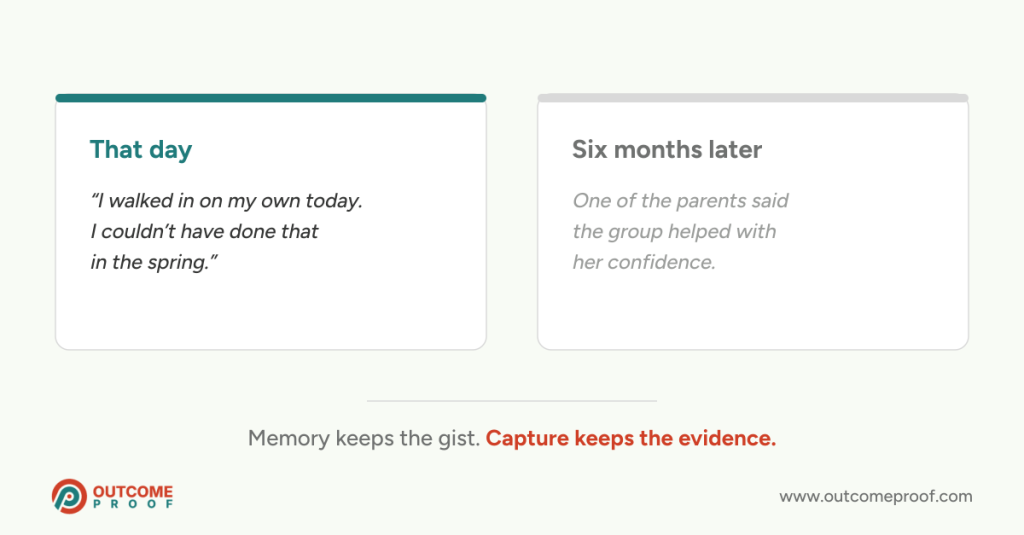
The reason evidence goes missing is not carelessness. It is that memory keeps the gist and loses the words, and in impact reporting the words are the evidence.
On the day, a parent says: “I walked in on my own today. I couldn’t have done that in the spring.” Six months later, what survives is: “one of the parents said the group helped with her confidence.” Both are true. Only one of them belongs in a funder report, because only one of them lets the funder hear the person rather than the charity.
The same applies to numbers and small observations. On the day, you know that nine of the twelve regulars came back after the summer break. By the time the report is due, it has become “attendance held up well”. The detail is the difference between evidence and assertion, and detail is exactly what time strips away.
So the rule underneath everything else in this guide: the value of a piece of evidence is highest on the day it happens, and it falls every week after that.
Capturing takes a minute, not a form
“Collecting evidence” sounds like a data project, and that is why it doesn’t happen. What we mean here is smaller:
- A quote, in the person’s own words, with a line of context. Twenty seconds.
- A number, at the moment you know it: how many came, how many came back, what the before-and-after scores were.
- A photo, where it’s appropriate: the full room, the finished garden, the artwork.
- A short note, two lines at most, recording something you noticed: “First time K contributed in the group without being asked.”
That is the whole job. Not a survey, not a write-up, not an evening of admin. If a capture is taking more than a minute, you are writing the report early rather than capturing evidence, and it will stop happening the first busy week.
If your work feels like the kind that can’t be evidenced at all, it almost certainly can be. Knowing what a good outcome looks like tells you what to keep an eye out for, and our guide to evidencing soft outcomes covers the kind of change that’s hard to count, like confidence or trust.
Same day beats perfect
A rough note captured today is worth more than a polished paragraph reconstructed next month. So capture at the first natural pause: at the end of the session, on the bus back, while the kettle boils. Date it, add a line of context (who, where, what was happening), and stop.
Don’t tidy the words. “It’s the only place I don’t feel like a patient” is evidence precisely because nobody in a charity office would have written it that way. The polish belongs in the report, later. The capture’s only job is to keep the moment alive until then.
When the moment is wrong, wait
Here is the part that matters most in support work, and that rarely gets said out loud: sometimes capturing in the moment is the wrong thing to do.
If someone has just told you something hard, reaching for a phone would break the moment and the trust. If you are supporting people through crisis, homelessness, bereavement or recovery, there will be conversations where writing anything down while you are in them would be intrusive. And people differ widely in what they are comfortable having shared: some are glad to be quoted or photographed, others would be mortified, and the same person may feel differently about different moments.
None of that is a reason to give up on evidence. It is a reason to capture afterwards: step out, finish the visit, and then take your minute. The words will still be fresh the same day. Ask before you quote someone by name or use a photo, note what they were happy with alongside the capture itself, and when in doubt, capture the observation without the identity (“a resident told us the drop-in is the only place he doesn’t feel judged”).
The aim was never to record everything instantly. It is to make capture easy when the moment is right, and easy afterwards when it isn’t.
Whoever saw it, captures it
In most small charities, the person who writes the funder report was not in the room when the evidence happened. The session worker saw it, the volunteer heard it, and the report writer six months later gets whatever survived the retelling.
So the habit has to belong to the whole team, not to whoever owns the report. That has two practical requirements. First, everyone agrees it is legitimate work: a captured quote is a contribution to the funder report, made months early, by the only person who could have made it. Second, the capturing has to be possible where the work happens, which today means a phone. If your team can open something in the phone’s browser and be done in under a minute, with nothing to install and no laptop involved, capture can happen in the car park straight after the session, and it will.
Aim small: one piece a week
The capture habits that survive are the ones with unambitious targets. One piece of evidence per person per week is plenty: one quote, one number, one photo or one note.
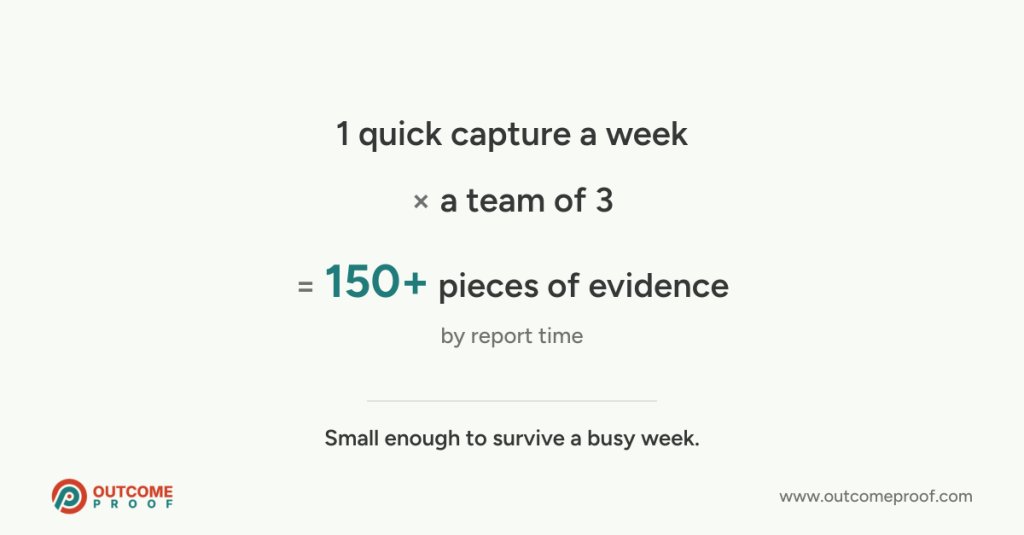
The arithmetic is quietly dramatic. One capture a week from a team of three is more than a hundred and fifty pieces of evidence by report time, each one dated, specific and in the moment’s own words. Most small charities have never sat down to write a funder report with a fraction of that behind them.
And the target being small is what protects it. A missed week costs nothing and needs no catching up; the habit resumes at the next session. If you aim to capture everything, the habit dies the first time the week gets loud.
Give every piece a home before you need it
One honest caveat: a phone full of captures is better than a memory full of moments, but it is still a pile. For a very small team reporting to a single funder, a shared folder and a notes file will hold that pile perfectly well, and if that is your situation, start there rather than not starting.
Where the pile approach strains is everything after capture. When the report is due, someone has to remember what exists, find it across everyone’s notes and photos, and work out which of your outcomes each piece actually speaks to, for each funder that asks. That is the hour-consuming part, and it is the part you can remove at capture time: when each quote, number, photo or note is attached to the outcome it evidences as it is captured, ten extra seconds each, the report assembles from material that is already sorted, already attributed and already findable by whoever writes it.
Start this week
Pick your outcomes if you haven’t already (our example outcomes for small charities are a quick way to start). Agree the one-a-week target with the team. Capture the first quote at the next session, the same day it happens.
If a capture habit like this is what your charity needs, it is exactly what Outcome Proof is designed around: capture a quote, number, photo or note in the moment from any phone, nothing to install, and it is linked to your outcomes and waiting when the funder report is due. You can try it free for 14 days. No setup fees, no sales calls, cancel anytime.