
If a funder has ever asked your charity to describe its “outcomes” and you weren’t quite sure what they wanted, you’re in good company. It’s one of the most common sticking points in funder reporting, and most of the confusion comes from one simple mix-up: writing down what you did, when the funder is asking what changed. This guide clears that up, shows you what a good outcome looks like, and explains why getting it right makes every report you ever write easier.
Activity, output, outcome: the distinction that fixes everything
Almost every reporting headache starts with these three being muddled together. They’re easy to separate once you see them side by side:
- An activity is what you do. “We run a weekly youth group.”
- An output is what you can count. “40 sessions over the year, with 65 young people attending.”
- An outcome is what changes for the people you serve. “Young people who attend regularly tell us they feel more confident, and the group we track are attending school more often.”
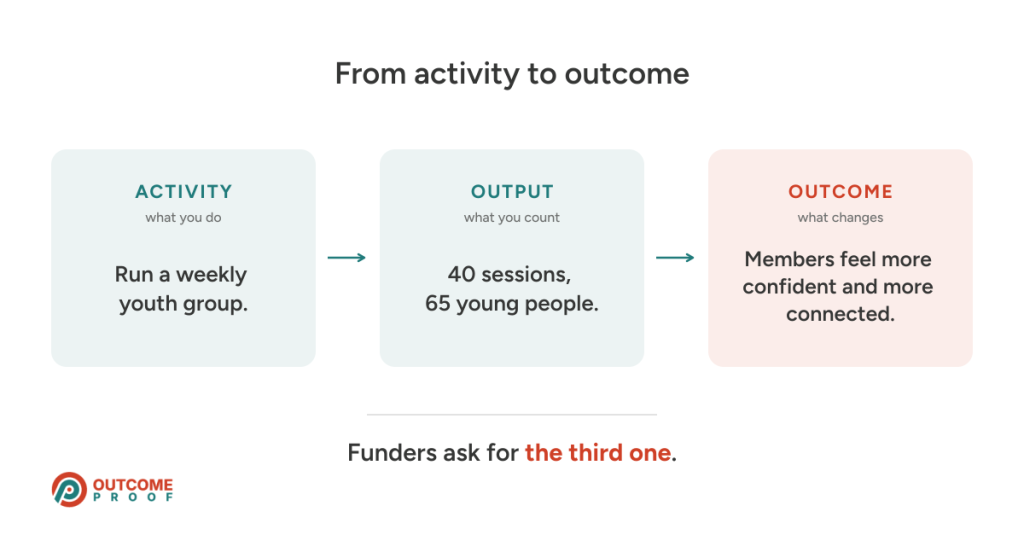
Outputs are real and worth recording. But on their own they describe effort, not difference. A funder reads “we ran 40 sessions” and still has to ask “and so what changed?” An outcome answers that question before they ask it.
A useful test: if a sentence would still be true even if your work had no effect on anyone, it’s an output, not an outcome. You can run 40 sessions to an empty room. You cannot make someone more confident without something actually changing.
Why funders ask for outcomes
Funders aren’t being awkward when they ask for outcomes. They’re accountable to their own boards and donors for the change their money creates, so they need to be able to describe that change, not just the activity it paid for. When you report in outcomes, you’re handing them exactly what they need to justify funding you again. You’re also making your own case stronger: “we changed this for these people” is far more persuasive than “we were busy”.
The shape of a good outcome
A good outcome names two things: who changes, and what changes for them.
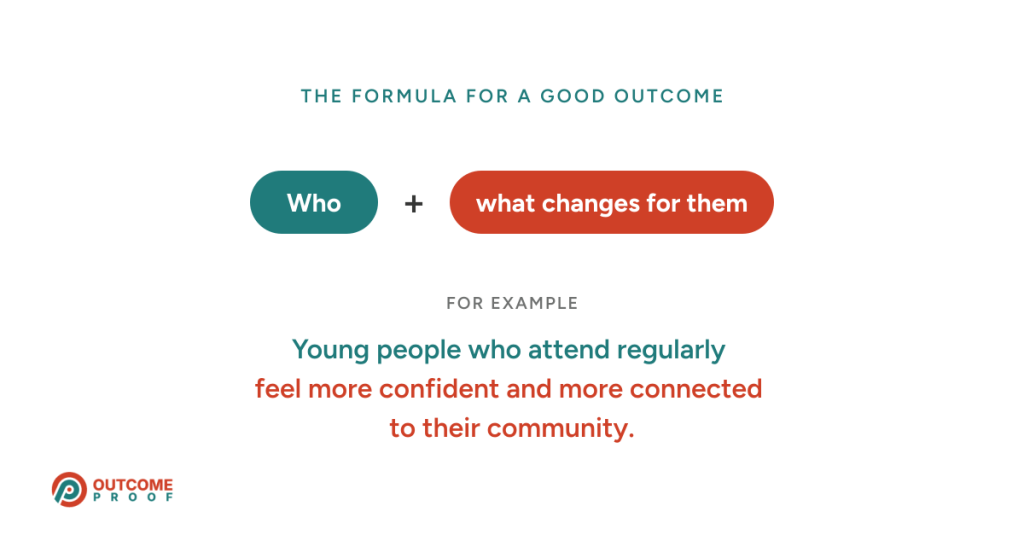
That’s it. Who: young people who attend regularly. What changes: they feel more confident and more connected. You don’t need grand language or a measurement framework to write that sentence. You need to be clear about the difference your work is trying to make, and honest about it.
Notice it doesn’t promise the world. It doesn’t say “we transform every young person’s life”. It says something specific and believable, which is exactly what you’ll be able to back up with evidence later.
Five common mistakes (and the easy fix for each)
- Describing the activity instead of the change. “We provide counselling” is an activity. The outcome is what counselling does for people: “People leave feeling more able to cope with what they’re facing.” The same slip hides in outcomes written from the receiving end. “Job seekers get one-to-one help with their CVs” sounds like a change for someone, but it’s still the activity, seen from the other side of the table. The change is what the help makes possible: “Job seekers feel ready to apply for work, and more of them are getting interviews.” Fix: after writing your sentence, ask “so what’s different for someone now?”
- Being too vague. “We improve wellbeing” could mean anything. Improve whose wellbeing, and how would you know? Fix: name the group and the specific change.
- Writing too many. A long list of outcomes is harder to evidence and weaker to read than a focused few. Fix: pick the three to six changes that matter most.
- Claiming more than you can show. An outcome you can’t back up with anything reads as a hope, not a result. Fix: only claim what you’d be comfortable showing a quote, a number, or an example for.
- Using jargon. “Enhanced social capital among service users” makes a funder work to understand you. Fix: write it the way you’d say it to a friend.
How many outcomes should you have?
Fewer than you think. For most small charities, a handful of clear outcomes covers the real difference you make. A focused set is easier to collect evidence for, easier for a funder to follow, and easier to keep honest. If you’re running very different kinds of work, you might group outcomes under each programme, but resist the urge to write an outcome for everything you do.
The payoff: an outcome tells you exactly what evidence to collect
Here’s the part that makes outcomes worth the effort, beyond keeping funders happy. Once you’ve named an outcome, you’ve also told yourself what to look out for all year.
Take “young people feel more confident and more connected”. Ask: what would I see or hear if that were really happening? Probably some of these:
- A quote. A young person saying something that shows the change in their own words.
- A number. Attendance holding steady, or the share of regulars who say they feel more confident.
- A photo. The group running an event they’d never have led a year ago.
- A note. A youth worker recording the moment a quiet member first spoke up.
That list is your evidence plan, and it fell straight out of the outcome. This is why a clear outcome is worth the ten minutes it takes to write: it turns “we should gather evidence” into “here are the four specific things to capture”, and it means that when a report is due you’re assembling material you already have, not starting from a blank page in March.
If the change you make is a feeling or a relationship rather than a number, our guide to evidencing soft outcomes shows what counts as evidence.
A worked example
A small youth charity starts with how it would naturally describe itself:
We run a weekly youth group with around 65 young people.
That’s the activity and the output. Now the outcome, the change it’s actually there to create:
Young people who attend regularly feel more confident and more connected to their community.
And immediately the evidence to collect through the year:
- a short quote from a member about what the group has meant to them
- the proportion of regular attendees who say they feel more confident, from a simple end-of-term ask
- a youth worker’s note about a specific young person who took on a role they’d have avoided before
- a photo from a community event the young people organised themselves
When the funder report comes round, the charity isn’t trying to remember last spring. The outcome is written, the evidence sits against it, and the report is an afternoon’s work instead of a fortnight of dread.
If youth work isn’t your field, you’ll find starting points like this for other kinds of work in our guide to example outcomes for small charities.
The habit that makes all of this easy
Writing a good outcome is a one-off effort. Living up to it is the year-round bit, and it comes down to a single habit: capture evidence against your outcomes as it happens, rather than reconstructing it at the end. A quote noted the day it’s said. A number recorded when the term ends. A photo saved where you’ll find it, linked to the outcome it shows.
You don’t need special software for this habit: a tidy folder will do, and so will a spreadsheet in the early days. What matters is that each piece of evidence lands somewhere findable on the day you get it, filed against the outcome it belongs to, so that when a report is due you’re reviewing material you already have instead of hunting for what you’ve lost.
The full version of that habit, what to capture, when, and how to make it something the whole team does, is in our guide to capturing impact evidence as it happens.
About Outcome Proof
To be straight with you: you don’t need Outcome Proof to write a good outcome. A notebook will do that fine. Where a notebook starts to creak is the year-round part: capturing evidence against every outcome, keeping it findable by your whole team, and pulling it together for a different funder every few months.
That is what Outcome Proof is for: a simple tool for small charities to capture evidence against their outcomes all year, so it’s organised and ready when any report is due.
If capturing evidence against your outcomes all year sounds like the habit your charity needs, you can try Outcome Proof free for 14 days. No setup fees, no sales calls, cancel anytime.
Ready to simplify your reporting?
Organise your evidence by outcome throughout the year, and generate your next report with far less effort. Designed around small charities.