
If your charity is funded by more than one or two funders, you’ll know the feeling: each one has its own form, its own format, its own deadline and its own way of asking. So every few months someone sits down, opens last quarter’s report, and starts copying, pasting and reworking the same material into yet another shape. It’s slow, it’s demoralising, and it always seems to land in the busiest week of the term.
This guide is about a different way to run it. Not a trick for writing faster, but a change in how you organise the underlying material, so that each funder report becomes a job of assembly rather than authorship.
Why multi-funder reporting hurts (and whose fault it isn’t)
Each funder designs their reporting form on its own terms, and taken one at a time, their questions are entirely reasonable. Each of them answers to a board and donors of their own, so each needs to understand what their money did.
The problem is that no single funder sees the sum. You do. Six funders asking reasonable questions in six different shapes adds up to a reporting burden nobody designed and nobody intended. Recognising that matters, because it tells you the fix isn’t to resent the forms or to hope they converge. The fix is on your side of the fence: build your material once, in a shape that can feed all of them.
Different forms, same six questions
Here’s the liberating part. Underneath the different vocabularies (“impact”, “outcomes”, “achievements”, “the difference made”), almost every funder report is asking the same six things:
- What did you do? The activities their grant supported, and the numbers that go with them.
- What changed for people? The outcomes: what’s different for the people you serve.
- How do you know? Evidence. Quotes, stories, numbers, examples, the voice of the people you work with.
- What was hard, and what did you learn? Honest reflection, which good funders value more than a perfect story.
- What’s next? Where the work goes from here.
- How was the money spent? A straightforward account of the grant.
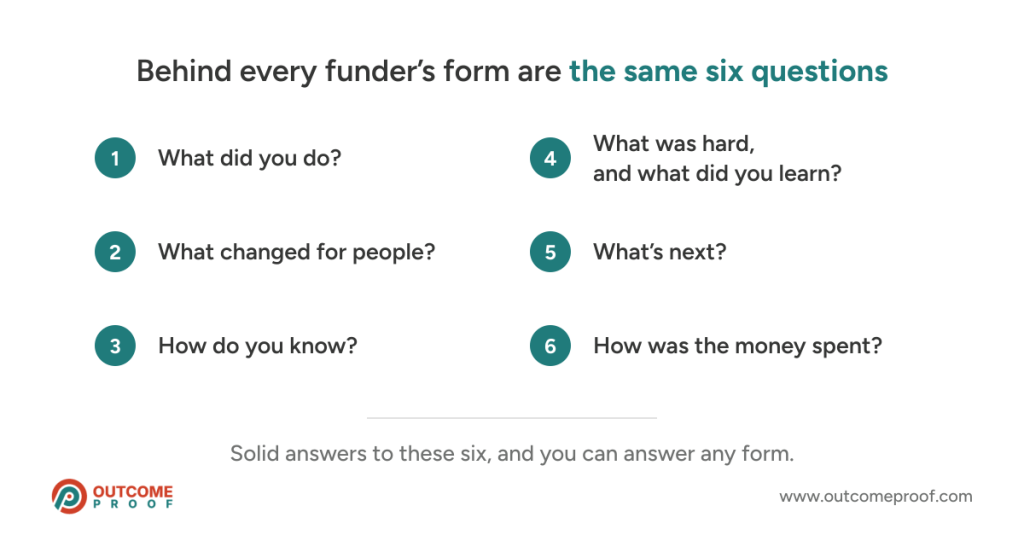
One funder might spread these over twelve questions, another over three. But if you have solid material for these six, you can answer any funder’s form. That’s the insight the rest of this guide builds on: stop preparing for each funder’s questions, and start maintaining one set of material that answers everyone’s.
Organise by outcome, not by funder
The instinct most charities follow is to organise by funder: a folder per funder, a report per funder, evidence saved wherever it happened to land. It feels logical, but it’s what creates the copy-paste problem, because the same underlying work ends up described separately, from scratch, for every funder who supports it.
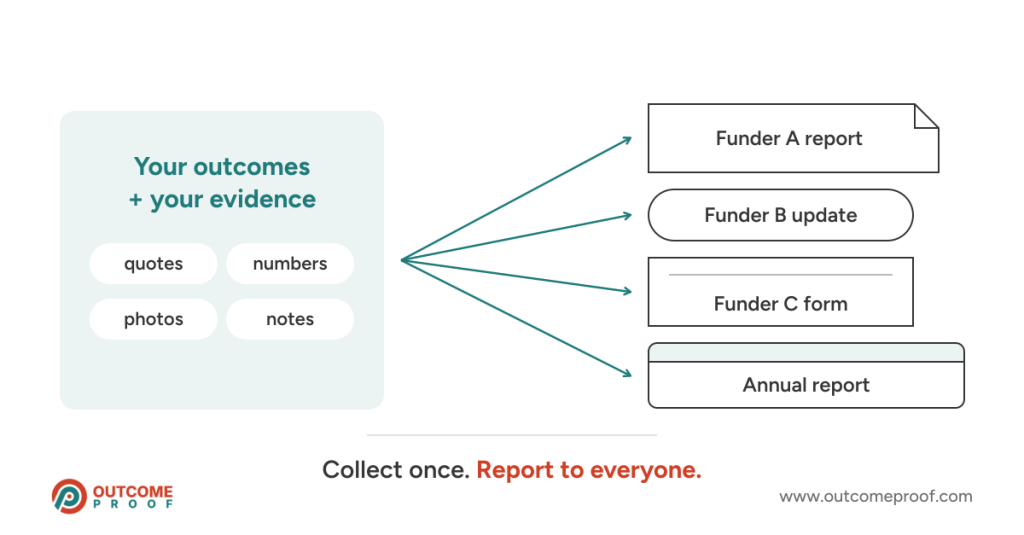
Flip it. Organise by outcome: the changes your work creates for people. Your outcomes are the same no matter who’s asking. The youth group builds confidence whether it’s the community foundation or the local trust asking about it. So:
- Keep one set of outcomes for your work (a focused handful, clearly written).
- Collect all your evidence against those outcomes, in one place, regardless of which funder it will eventually serve.
- When a report is due, select and assemble: pick the outcomes that funder cares about, lift the current evidence and narrative for each, and fit it to their format.
If you’re not sure your outcomes are in good shape, start with our guide to writing a good outcome; everything below works better when the outcomes are clear.
Setting it up: four steps
1. Write your outcomes once. Three to six clear outcome statements covering the real difference your work makes. This is the spine everything else hangs on.
Then check them against what you’ve already promised. Each application will have committed to outcomes in that funder’s language, and most turn out to be one of yours phrased differently: “increased confidence” in one application and “improved self-esteem” in another usually describe the same change in the same young people. Note which of your outcomes each promise belongs to. Where a funder has asked for something genuinely separate, such as a target you don’t otherwise track or a group only their grant reaches, give it an outcome of its own rather than stretching one of yours to cover it.
2. Map your funders’ questions to the six questions above. Take each funder’s form and note, next to each of their questions, which of the six it’s really asking. This takes an hour and removes the fear from every form you’ll ever face: there are no new questions, only new phrasings. While you’re there, note each funder’s deadlines in one calendar, along with the period each report covers. Funders rarely share a reporting year: one may report on the calendar year, another on its own financial year, a third on the anniversary of its grant. Reporting stops being a surprise when it’s laid out as a year.
3. Capture evidence against outcomes as it happens, all year. This is the habit that changes everything. A participant’s comment captured while it’s still fresh. Attendance figures added when the session wraps up, not six months later. A photo dropped in from a phone before it sinks into the camera roll, filed against the outcome it shows. Captured in the moment, each item takes seconds. Reconstructed in reporting week, it takes hours, if it can be found at all. Give each item the date it happened, not the date it was filed, so every report can draw on exactly the months it covers.
4. Keep a short living note per outcome. A few sentences per outcome, updated whenever something notable happens: what’s going well, what’s proving hard, what you’re learning. This is the reflective material for questions four and five, and it means the narrative in your reports is written in small pieces through the year, by the people closest to the work, rather than composed from memory at the deadline.
What report time looks like after the flip
A funder report lands. Instead of a blank page, you have: the outcomes that funder supports, the evidence collected against each over the period this report covers, and a living note per outcome that already says how it’s going. The job is now selection and fitting: choose what’s relevant to this funder, trim it to their word counts, put it in their order, and add the spend figures.
And the material gets reused honestly. The quote a participant gave in a session in October can appear in one funder’s spring report, another funder’s summer update and your annual report, and it was captured once. That isn’t copy-paste drudgery; that’s a single piece of genuine evidence doing its full job. The drudgery was never the reuse. It was the hunting, the reconstructing and the rewriting from scratch.
For the writing itself, how to write a funder report takes one report from the application through to the last check before you send it.
Do you need software for this?
Honestly: not always. If you report to one or two funders, a tidy shared folder, a spreadsheet of evidence and a diary reminder to update your outcome notes each month will genuinely work, and we’d rather you did that than believe reporting requires special tools.
The folder-and-spreadsheet version holds up until scale arrives: five or more funders with deadlines scattered across the year and reporting periods that don’t line up, several colleagues capturing evidence in different places, and the person writing the March report needing to find the October quote that someone else recorded, filed under a name nobody remembers. At that point the system itself becomes a job, and it’s usually the moment the whole thing quietly collapses back into copy-paste.
About Outcome Proof
Everything in this guide works on paper. The reason we built Outcome Proof is that keeping it working is the hard part: across a whole team, a whole year and every funder’s different deadline. Outcome Proof is a simple, affordable tool for small charities that holds your outcomes and your evidence in one place, captured as it happens, so any funder’s report starts mostly written.
If one evidence base feeding every funder report sounds like what your charity needs, you can try Outcome Proof free for 14 days. No setup fees, no sales calls, cancel anytime.
Ready to simplify your reporting?
Organise your evidence by outcome throughout the year, and generate your next report with far less effort. Designed around small charities.