
Impact reporting tools change. They get acquired, they get discontinued, they change price, or they evolve towards bigger organisations and quietly away from you. None of that reflects on your work or on the choice you made at the time: a tool can have served you well and still stop being the right home for what you do.
What makes the situation stressful is the sense that years of evidence, reports and thinking are locked inside it, and that moving means losing them. That fear is understandable, and it is mostly wrong. Your impact record can survive a change of tools intact. It just has to happen in the right order, and the order is the whole trick.
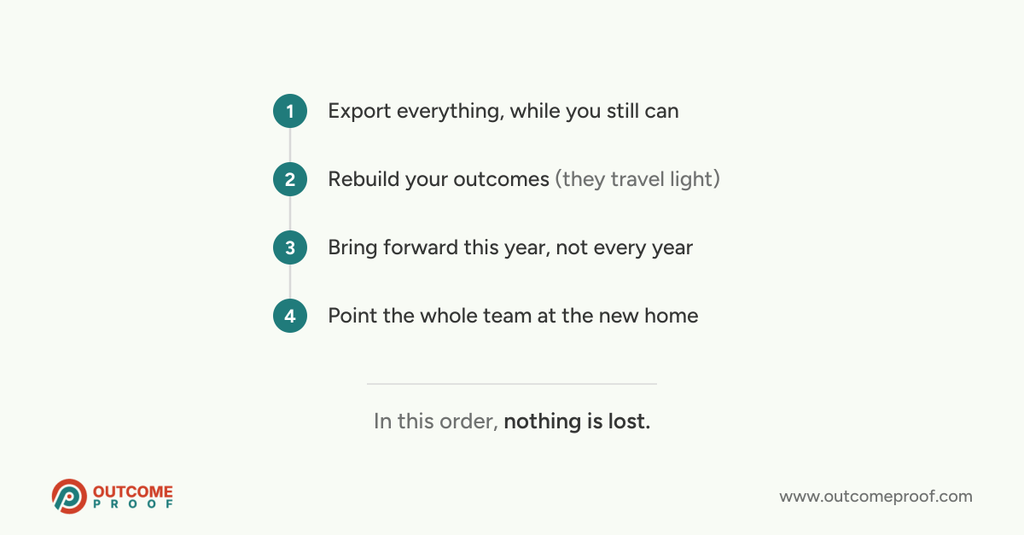
1. Export everything first, decide later
Before you compare a single alternative, get your data out of the tool you have, while your access is at its best.
- Submitted reports: download every report you have ever sent a funder, as Word documents or PDFs. These are finished, evidenced pieces of your history, and they are the thing you would miss most.
- Evidence: export whatever the tool holds, in whatever format it offers. A spreadsheet export with odd column names is fine; you are preserving, not presenting.
- Your outcome framework: the outcomes themselves, however the tool lets you get them. If there is no export for this, screenshots are genuinely fine. It is a page or two of thinking, and the thinking is what you are keeping.
Do this even if you are not sure you are moving. An export you never need costs an afternoon. The other way round costs years, and export options have a way of being at their best while a service is running normally, not in its final weeks.
2. Your outcomes travel light
Here is the reassuring structural fact about moving: the most valuable thing in your old tool is also the easiest thing to move, because your outcome framework is thinking, not data.
The outcomes your charity works towards fit on a page. Setting them up again in a new home is an afternoon’s work, not a project, and doing it by hand has a value of its own: it is the natural moment to prune. Keep the outcomes you actually reported against. Retire the ones that never earned a piece of evidence or never made it into a report. Most organisations come out of a move with a shorter, sharper framework than they went in with, and (if you would like a refresher first) what makes an outcome worth keeping is its own short read.
3. Don’t try to move everything
The instinct in any move is to take it all with you. Resist it. Bulk-transferring years of history between tools rarely works cleanly, whatever you are moving between: formats differ, structures differ, and you can lose a fortnight to a spreadsheet-wrangling project that nobody will ever thank you for. We would rather say that plainly than pretend otherwise, and it applies to us too: Outcome Proof doesn’t bulk-import another tool’s history either.
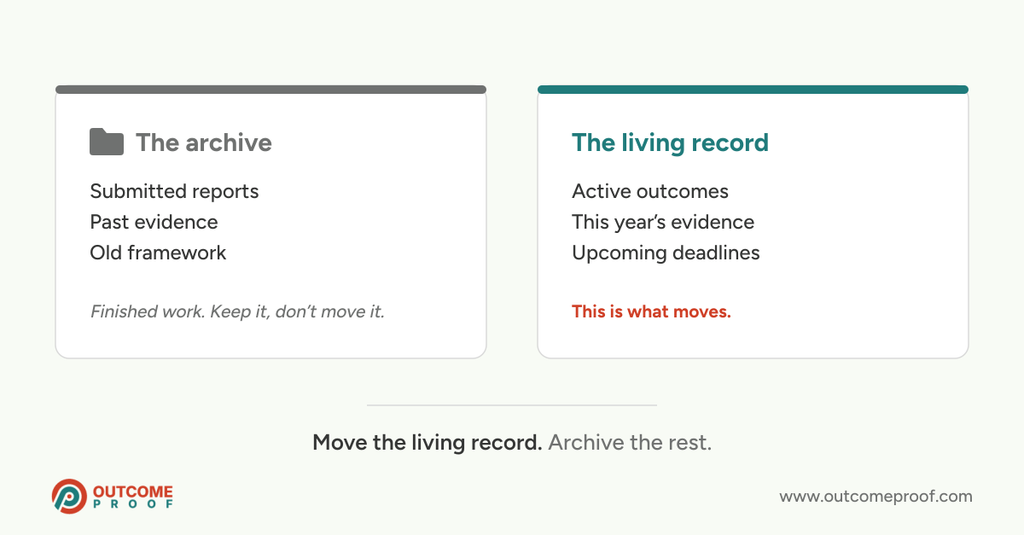
The liberating part is that you don’t need to. Look at what your history actually is:
What is alive is small: the outcomes you are working towards now, the evidence from your current reporting year, and the deadlines ahead of you. That is the living record, and it is the only part that moves.
Submitted reports are finished work. They have done their job. They belong in your archive (the exports from step 1), not in your next tool.
Old evidence has mostly been used. The quotes and numbers from three years ago are in the reports they supported. A folder of exports and a spreadsheet make a perfectly good archive for them, and an archive is all they need.
4. Start the new home fresh, and let it fill
Set up the new tool with your (pruned) outcomes and your upcoming funder deadlines. Add this reporting year’s evidence, and from then on capture new evidence as it happens rather than back-filling the past. If there are a handful of archive pieces you know you will reuse (the flagship quote, the headline numbers), bring those in as you actually need them, not in one migration weekend.
Within a single reporting cycle, the new tool is your living record and the export folder is your reference library, and that division keeps being the right one: the archive holds what happened, the tool holds what is happening.
5. Choose so you never have to do this again
One thing worth carrying out of the experience: the next tool should be one you could leave easily, because a tool that is easy to leave is a tool that has to keep earning you. Look for a complete export you can run yourself at any time without asking, a rolling monthly arrangement rather than lock-in, and a price your charity can sustain year after year. We have written a full guide to exactly this: is your charity’s impact data future-proof?
If you are moving now
Export first. Prune and rebuild your outcomes. Bring this year forward and archive the rest. Move the whole team at once, so capture doesn’t fall between two stools.
And if you are looking for the new home: Outcome Proof is a simple, affordable impact reporting tool designed around small charities, where capturing a piece of evidence takes a minute from any phone, and your funder reports draw on everything you’ve captured. Your data stays yours throughout, and you can run a full export yourself whenever you like. You can try it free for 14 days. No setup fees, no sales calls, cancel anytime.