
If you’ve seen headlines about SORP 2026 making impact reporting mandatory and felt a flutter of panic, here’s the honest version: for small charities, the new requirement is genuinely light. This guide explains what’s actually changing, what you need to do, and where the real reporting challenge for small charities still lies.
What is SORP 2026?
The Charities Statement of Recommended Practice (SORP) sets out how charities across the UK prepare their annual reports and accounts when they produce full accounts (known as accruals accounts). The 2026 edition was published in October 2025 and applies to accounting periods starting on or after 1 January 2026. The headline change is in the trustees’ annual report, which now asks for impact reporting: an explanation of not just what your charity did, but what changed as a result.
Does SORP 2026 apply to your charity?
Not every small charity follows SORP. It applies to charities that prepare accruals accounts. Charitable companies prepare them whatever their income, so they are always on SORP. Other charities (trusts, associations and CIOs) can usually choose simpler receipts-and-payments accounts below an income threshold, and if they do, SORP doesn’t formally apply to them.
Either way, the trustees’ report asks for much the same thing. For charities in England and Wales preparing receipts-and-payments accounts, the Charity Commission’s guidance is plain: “You must give a summary of the charity’s main achievements during the year”, which could include “how your charity’s work has made a difference to its beneficiaries”. So whichever rules apply to you, the job is a short, honest account of what changed, and the rest of this guide works for both.
The three tiers, and why yours probably has it easy
SORP 2026 scales its requirements to charity size:
| Tier | Annual income | Impact reporting requirement |
| Tier 1 | Up to £500k | A summary of your main achievements during the year |
| Tier 2 | £500k to £15m | A review of performance against your aims and objectives |
| Tier 3 | Over £15m | Full impact reporting plus sustainability reporting |
If your charity follows SORP and its income is under £500k, it’s Tier 1. And the official guidance for Tier 1 is reassuringly plain: a few paragraphs summarising your main achievements, with a story or two. A beneficiary quote, a volunteer anecdote, a simple description of what changed because of your work. That’s it.
You do not need new software, a consultant, or an outcomes framework to comply. If your trustees’ report already says something honest and specific about what your charity achieved this year, you’re most of the way there. Many well-run small charities have been writing exactly this for years; SORP 2026 simply formalises what the Charity Commission already considered good practice.
When does it start?
It depends on your accounting year:
- Calendar-year charities (year ending 31 December): your 2026 report, typically filed in early 2027, is the first one affected.
- April year-end charities: your April 2026 to March 2027 report, typically filed in late 2027, is the first one affected.
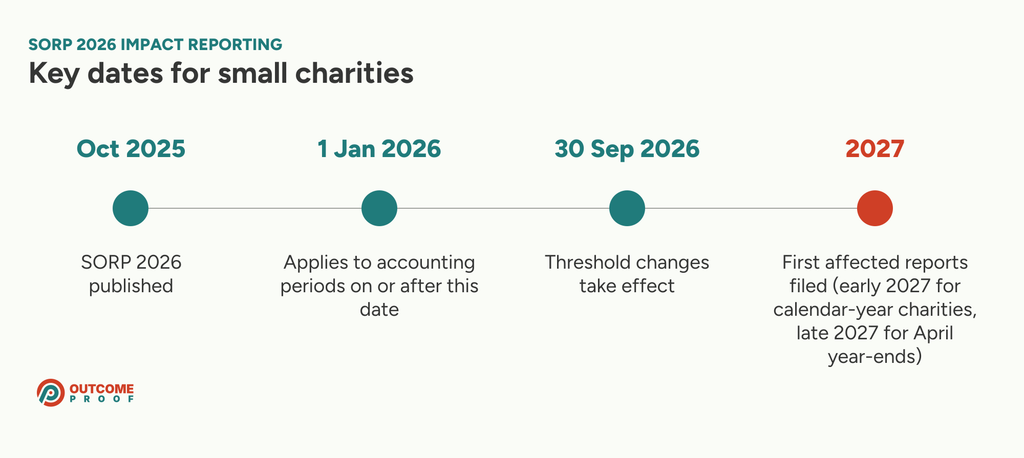
The filing is a while off, but the year it reports on has already started. For a calendar-year charity it ends on 31 December, and the quotes, numbers and moments that belong in that report are happening now. They’re far easier to note down as they happen than to piece together once the year has closed.
Some genuinely good news hiding in the same reforms
Alongside SORP 2026, the accounting thresholds in England and Wales rise for financial years ending on or after 30 September 2026, and they move in small charities’ favour:
- Independent examination is only needed above £40k income (up from £25k)
- A qualified examiner is only needed above £500k (up from £250k)
- Simpler receipts-and-payments accounts are allowed up to £500k income (up from £250k), for charities that aren’t companies
For many small charities the overall compliance burden goes down, not up.
Two things to check first. Some funders ask for independently examined accounts whatever your income, so look at what yours require before dropping an examination. And in Scotland only the audit threshold is changing (from £500k to £1m), so Scottish charities should check OSCR’s guidance rather than the figures above.
Outputs vs outcomes: the distinction worth understanding
The one genuinely new habit SORP 2026 asks of trustees is the shift from describing activity to describing change:
- An output is what you did: “We ran 40 weekly youth sessions with 65 regular attendees.”
- An outcome is what changed: “Two thirds of regular attendees told us they feel more confident, and school attendance improved for the group we track.”
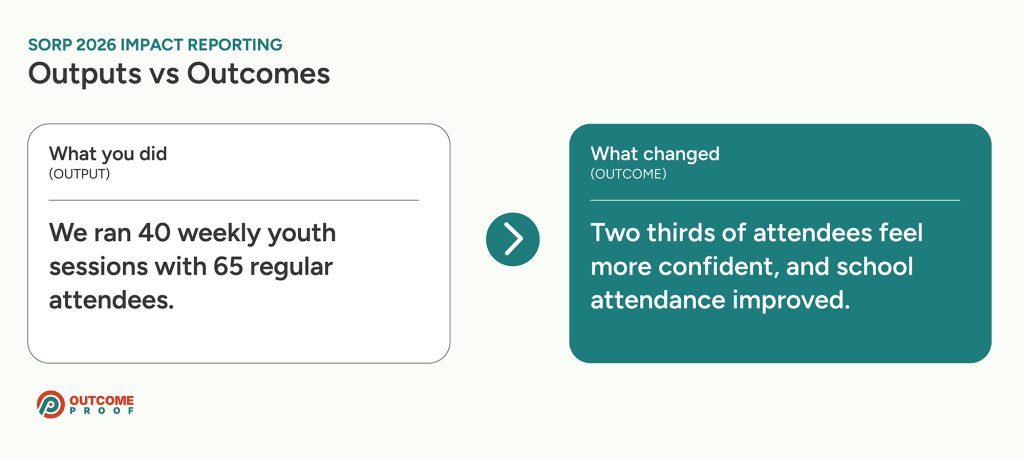
The regulator wants the link between your activities and their results to be honest, meaningful and accessible. Not impressive. Not statistically bulletproof. Honest, meaningful and accessible. For a small charity, one good beneficiary story that shows real change is worth more than a page of numbers.
Our guide to writing a good outcome covers the difference in more depth.
How to write a good achievements summary
When you sit down to write those few paragraphs:
- Pick two or three achievements that mattered, not everything you did. The strongest reports are selective.
- Show change, not just activity. For each achievement, add one sentence on what’s different for the people you serve.
- Use a real voice. A short, direct quote from a beneficiary or volunteer does more work than any statistic.
- Be honest about the hard parts. If something didn’t work, saying so (and what you learned) reads as credibility, not failure. The Charity Commission has been clear it wants meaningful engagement, not a tick-box exercise.
The real challenge isn’t the writing. It’s having the material.
Writing four paragraphs is easy if you have the material in front of you: the quotes, the numbers, the moments that showed your work landing. It’s miserable if you’re starting from a blank page in March, trying to remember what happened last spring, digging through old emails and asking colleagues “didn’t someone say something lovely about the Tuesday group?”
And for most small charities, the trustees’ report is the lightest version of this problem. The heavier version happens all year round: every funder wants their own report, in their own format, on their own schedule, and each one sends you back to the same scattered pile of evidence. SORP 2026 adds one more document to a stack that already exists. Our guide to reporting to multiple funders covers that heavier version.
The charities that find all of this easy share one habit: they capture evidence as it happens. A quote gets noted the day it’s said. A photo gets saved where it can be found. Survey results land somewhere organised, linked to the outcome they demonstrate. When reporting time comes, whether it’s for a funder or for the trustees’ report, the material is already there and the writing takes an afternoon.
That habit needs a system, but the system matters less than the habit. A well-organised folder structure can work. So can a spreadsheet, for a while. The point is to stop treating reporting as an annual archaeology project and start treating evidence as something you collect all year. Our guide to capturing impact evidence as it happens shows what that looks like week to week.
About Outcome Proof
Outcome Proof is a simple tool built around exactly that habit, for small charities. You set up the outcomes you care about, capture evidence against them all year (quotes, numbers, photos, notes, from your desk or your phone), and when any report is due, the material is organised and ready.
An achievements summary can be written in Word, and if the trustees’ report is the only one your charity produces, that is a fine place to leave it. Outcome Proof earns its place further along, once the same evidence is being asked for by the trustees and by three funders on three different schedules, and the collecting has to happen months before anyone asks.
Sources and further reading: the Charity Commission’s guide to preparing a trustees’ annual report, GOV.UK guidance on changes to charity accounting and reporting, ICAEW on Charities SORP 2026, and the Charities SORP-making body’s reflections on the 2026 consultation. Information correct as of October 2026; check current guidance for your charity’s specific circumstances.
If year-round evidence capture sounds like the habit your charity needs, you can try Outcome Proof free for 14 days. No setup fees, no sales calls, cancel anytime.
Ready to simplify your reporting?
Organise your evidence by outcome throughout the year, and generate your next report with far less effort. Designed around small charities.