
Sometimes the quickest way to understand what a good outcome looks like is to see a few. This guide gives you example outcomes across the kinds of work small nonprofits do, along with the evidence you’d collect to back each one up. Use them as starting points to adapt to your own work, not templates to copy: an outcome only helps you if it’s honestly yours and you can show it’s happening.
If you’re not yet sure what separates an outcome from an activity or an output, start with our guide to writing a good outcome. Everything below builds on the simple shape it sets out.
How to use these examples
A few things worth holding in mind as you read:
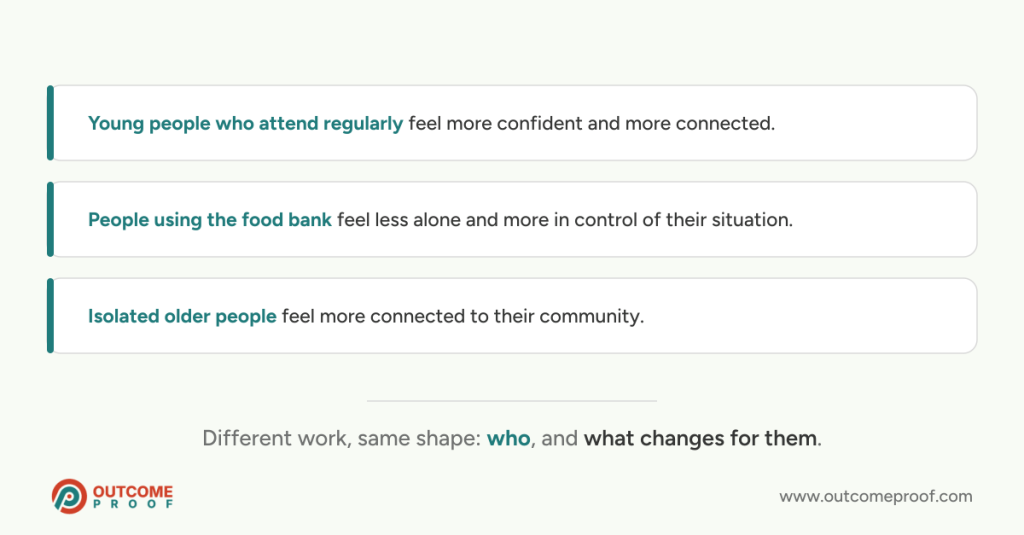
- A good outcome names two things: who changes, and what changes for them. Every example below follows that shape.
- Pick a focused few. Three to six outcomes is plenty for most small nonprofits. Spreading yourself across a dozen makes every one of them harder to back up.
- Make them yours. Change the wording so it sounds like your work and describes the change you actually see. A borrowed outcome you can’t evidence won’t survive its first grant report.
- Let each outcome tell you what to collect. For every example we’ve listed the kind of evidence that would show it. That evidence list is the practical payoff of naming the outcome.
Youth and children
Work with young people: youth groups, mentoring, after-school and holiday activities, support for children facing disadvantage.
- Young people who attend regularly feel more confident and more connected to others.
- Young people develop skills and interests they can carry into education, work or their community.
- Children feel safer and more supported, at home, at school or in their community.
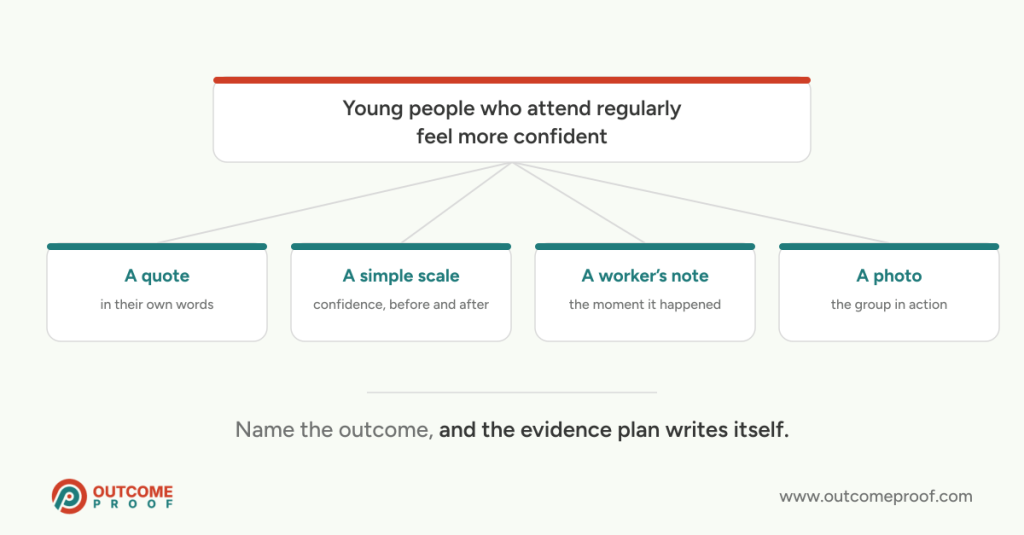
Evidence you might collect: a young person’s own words about what’s changed for them; a two-question confidence check each session, tracked across the year; a leader’s note about a quiet member stepping up to run something; a photo of the group in charge of something that used to be run for them. (This is the worked example our guide to writing a good outcome builds step by step.)
Mental health and wellbeing
Counseling, peer support, wellbeing groups, crisis and recovery support.
- People feel more able to cope with the challenges they’re facing.
- People feel less isolated and more supported in their mental health.
- People take steps to manage their own wellbeing that they weren’t taking before.
Evidence you might collect: a simple before-and-after wellbeing check-in to show distance traveled; a quote in someone’s own words about what’s different; a note on a concrete step someone has taken (returning to work, reconnecting with family); attendance holding steady among people who used to drop out.
Food, hardship and the cost of living
Food banks, community pantries, summer meals, emergency support, money and debt advice.
- People experiencing hardship can meet their immediate needs with dignity.
- People feel less alone and more in control of their situation.
- People are connected to the wider help they need, not just fed for a day.
Evidence you might collect: a quote about what the support meant at a hard moment; the number of people helped, and how many were connected on to further support; a volunteer’s note about someone who came back to volunteer themselves; a simple measure of how in-control people feel before and after getting advice.
Older people, loneliness and isolation
Befriending, lunch clubs, day services, support to stay independent at home.
- Isolated older people feel more connected to others and their community.
- Older people are able to stay independent and active for longer.
- Older people feel their days have more purpose and companionship.
Evidence you might collect: a simple connection score when someone joins and again at review time; a member’s words about what the visits mean to them; a befriender’s note about a first unprompted appearance at the group; a photo from a trip the members planned together. (Our guide to evidencing soft outcomes walks a fuller version of this example through, evidence plan and all.)
Employment, skills and training
Employability support, training, volunteering-into-work, support for people facing barriers to employment.
- People gain skills and confidence that move them closer to work.
- People take concrete steps towards employment, training or volunteering.
- People facing barriers to work feel more hopeful about their prospects.
Evidence you might collect: distance traveled towards work (from “not job-searching” to “applying” to “in work or training”); a quote about a shift in confidence; the number who moved into work, training or volunteering; a note from a tutor or mentor about a specific breakthrough.
Advice, advocacy and community support
Advice services, advocacy, community organizing, support for a particular community.
- People understand their rights and options and can act on them.
- People’s voices are heard in decisions that affect them.
- A community feels stronger and better able to support its own members.
Evidence you might collect: a quote about what changed after someone got advice or was supported to speak up; concrete resolutions (a benefits approved, a decision changed, an issue resolved); a note on someone who went from being helped to helping others; attendance or participation growing in a community activity.
Environment and community green space
Conservation, community gardens, climate and nature projects, green space for wellbeing.
- People feel more connected to nature and to each other through the project.
- A local green space is better cared for and more used by the community.
- People take up habits or actions that are better for the environment.
Evidence you might collect: a quote about what taking part has meant; simple counts (volunteer hours, area cared for, number of regular participants); a photo of a space before and after; a note on a participant who kept up a new habit or took on a role.
Arts and culture
Community arts, music, theater and dance groups, heritage projects, creative wellbeing.
- People who wouldn’t usually take part in the arts get involved, and keep coming.
- People gain creative skills and the confidence to share what they make.
- A community knows and values more of its own history and culture.
Evidence you might collect: a participant’s words about what making something has meant to them; the number taking part, and how many were new to the arts; a photo of the finished piece, the performance or the exhibition; a session leader’s note about someone who first shared their work in public.
Housing and homelessness
Homelessness services, supported housing, tenancy support, housing advice.
- People at risk of losing their home keep it, because the problems behind the risk are dealt with early.
- People who have been homeless move into settled accommodation and are supported to keep it.
- People feel their home is somewhere they can stay, not just somewhere to sleep.
Evidence you might collect: the number of tenancies kept or homes secured, and how many were still in place at the next review; a quote about what having a settled home has made possible; a support worker’s note on a step that would have been out of reach before (a first bill paid on time, signing up with a doctor); a photo of a room someone has made their own, taken with their agreement.
Specialist support
Support for survivors of domestic abuse, refugees and new arrivals, carers, and people in or leaving the justice system.
- Survivors of domestic abuse feel safer, and are rebuilding their lives on their own terms.
- Refugees and new arrivals feel welcome and can find their way to the services they need.
- People leaving prison find a settled place in the community, with somewhere to live and something to do.
Evidence you might collect: a short quote, shared with the person’s agreement and without anything that could identify them, about feeling safer or more settled; a simple safety or confidence check at the start of support and again at review; the number of people who reached a concrete milestone (a safe home, a course started, a first appointment kept); a worker’s note on a turning point. In this kind of work, how and when you capture matters as much as what: our guide to capturing impact evidence as it happens covers when to wait.
Turning an example into your own outcome
When you find an example near your work, make it real in three quick steps:
- Name your who. Be specific about the people you serve. “Young people who attend regularly” is stronger than “young people”.
- Name the change you actually see. Describe the difference honestly and plainly, and don’t claim more than you could show.
- List the evidence. Ask “what would I see or hear if this were really happening?” and you have your evidence plan for the year.
That’s the whole job: a clear outcome and a short list of the evidence that would show it. Ten minutes of naming now, and next year’s report is already half planned.
About Outcome Proof
An example outcome is only the beginning. Its value shows up over the following year, as you collect the quotes, numbers, notes and photos that prove it’s happening. And you don’t need us for that part: a folder or a spreadsheet will hold the evidence of a nonprofit with one or two outcomes and a single grantmaker. The job changes as the work grows: more outcomes, more hands adding evidence, more grantmakers asking, and each report needing the right pieces found quickly. That’s when a dedicated home starts paying for itself.
That is what Outcome Proof is for: a simple tool for small nonprofits to hold your outcomes and capture evidence against each one as it happens, so that when any report is due, the material is already organized and waiting. It comes with a library of ready-made outcome templates for the kinds of work on this page, each with suggestions for the evidence to collect, to adapt rather than copy.
Outcome Proof is open to UK charities now, and we’re coming to the US soon. If you’re reviewing your approach to outcome tracking, register your interest and we’ll email you the moment signups open. And we’d still love to hear about the challenges you’re facing and what you’d like software to do better; that’s what shapes what we build. In the meantime, everything in this guide works with the tools you already have.