
The grant is spent, the work happened, and now there’s a report form with eight boxes and a deadline in ten days. Whatever your funder calls it (a monitoring report, a progress update, an end-of-grant report), most small charities have plenty to say. The hard part is knowing what the reader wants to find.
If you only have an evening, here’s the order. Open the application and list the outcomes you promised. For each one, find a number, a quote and a note of where they came from, and write them up in four lines (below). Add a paragraph on what was hard, explain any money spent differently, and run the check under “Before you send it”. If ten days isn’t enough, or a question is unclear, or you’ve already written this year up for another funder, email and ask now, while the deadline is still more than a week away. The rest of this guide takes each step in turn, with one worked example running through it.
The report answers the application
A funder report is a reply to something you already wrote: the application. The funder said yes to it, and the report is where they find out what happened. If someone else wrote the application, find it anyway, because it’s the document the funder will have in front of them.
Before you write a word, pull out the outcomes you promised, any numbers attached to them and the people you said you’d reach. If the form has its own headings, these sit inside them. If it’s one blank box, they are your headings.
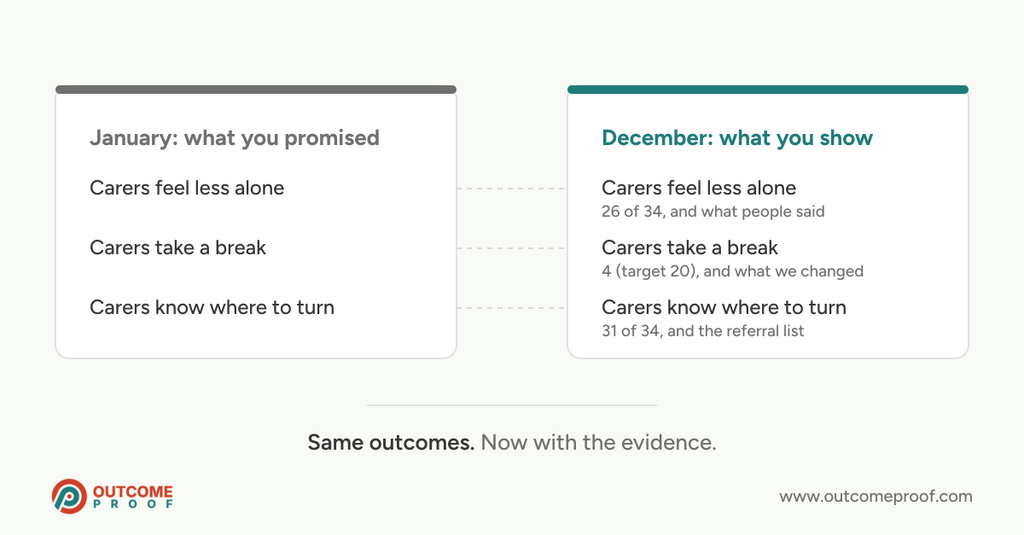
Plans move during a year, and funders know it. If an outcome was changed or dropped along the way, report against the version you and the funder last agreed, and say in a sentence what changed and why. What reads badly is an outcome from the application that quietly disappears from the report.
It works the other way too: the outcomes you promise in January are the ones you’ll be evidencing in December, so next time you apply, promise ones you have a realistic way to show. Our guide to writing a good outcome covers how.
What the funder is reading for
The person reading your report usually has a few questions to answer for their own trustees: did the work happen, did it make the difference the charity said it would, how do we know, and is there anything we should talk to this charity about?
A report that answers those quickly and specifically is the easiest kind to read, and funders say as much. Garfield Weston’s guidance for grant holders asks, “Please keep your report brief – aim for around two sides of A4!”, and asks for the main points in simple bullet points. Others present their report questions as ideas for what to cover rather than boxes you must fill. Detail matters more than length: what you did, for whom, and what changed.
Funders also ask about the difficult parts. Every funder whose reporting guidance we looked at does so in some form, and Esmée Fairbairn is especially direct: “We want to know when things don’t work out; why they don’t go well; and how you learn from it and use that knowledge to move forward.”
A shape that works for any form
If your funder has a form, use their headings and stay within their word counts. Underneath almost every form sits the same small set of questions, which we’ve set out in our guide to reporting to multiple funders.
When there’s no form, or the form is a single large box, this shape works:
- What the grant paid for, and what you did. A few sentences: who the work was for, the period covered, and what actually happened (sessions run, how many different people took part). If other funders supported the same work, say what this grant contributed to; funders know they are rarely the only one.
- One section per outcome. What changed, how you know, and in people’s own words where you can. This is most of the report.
- What was hard, and what you learned. One or two honest paragraphs, including anything you delivered differently from the plan.
- What happens next. What continues and what changes. Ask for anything you need, such as more time or a change to the budget, separately by email or phone; some funders, Garfield Weston among them, ask for requests that way so they don’t get missed. If the form has a box for changes, use that as well.
- The money. Their format, their figures. Where spending differed from the budget, add a sentence per line on why and what it meant for the work. A delayed start or a cheaper venue is unlikely to worry anyone; a gap with no explanation will. If money is left over, say how much and why, and ask the funder what they’d like done with it rather than rushing to spend it in the final month.
If the funder asks for a case study, it goes between items 2 and 3: one person’s story, anonymised unless they’ve agreed otherwise, told from before to after in a few paragraphs. Pick a typical story rather than the most dramatic.
Writing an outcome section: claim, number, voice, source
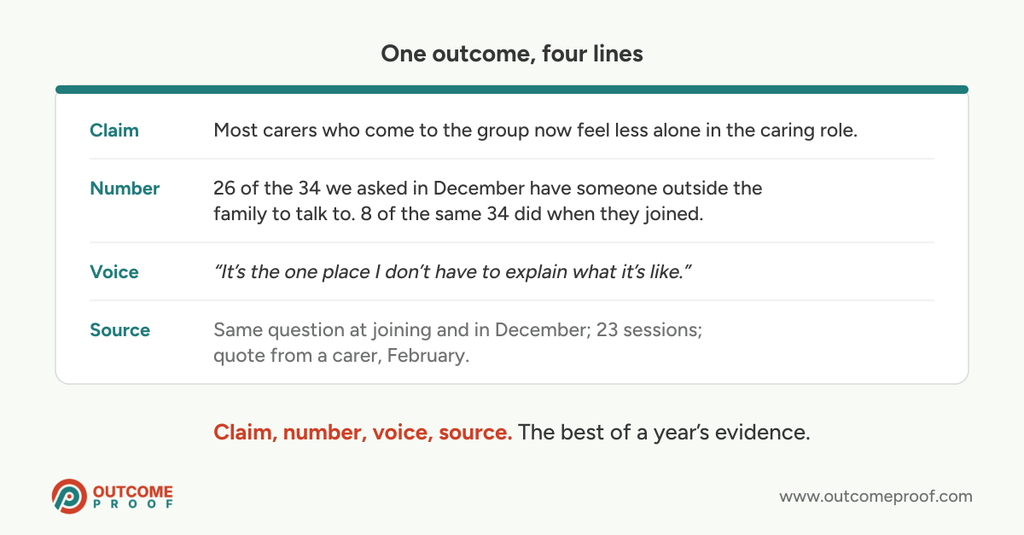
An outcome section needs four things, and each can be a sentence or two. Each line is the best of what you gathered through the year, picked for this report. The example below had a before-and-after question to draw on. If you don’t have one, there’s a way round that further down.
Picture a small charity that runs a fortnightly evening peer-support group for unpaid carers, funded for a year by a local trust. Its application promised three outcomes. The first was that carers who came would feel less alone in the caring role.
The claim. State the outcome plainly, as a change that has happened rather than one you hoped for. Most carers who come to the group now feel less alone in the caring role.
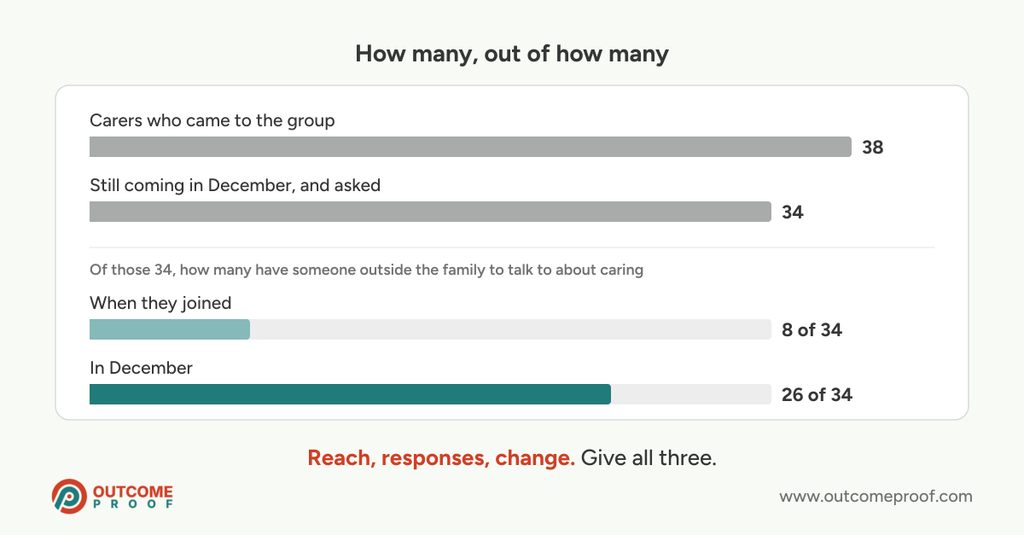
The number. Give the figure behind it, with its context. We asked the 34 carers still coming in December. When they joined, 8 had said they had someone outside the family to talk to about caring. By December, 26 did. Both figures are out of the same 34 people, and the sentence says when each was asked. Without that, a reader can’t tell whether 26 is good.
The voice. One quote, word for word, with a few words on who said it and when, and the person’s permission to use it. A carer who has come since the first session said in February: “It’s the one place I don’t have to explain what it’s like.” More carer quotes start to read like a brochure. A line from someone who saw the change from the outside, such as a volunteer or the person who referred them, does more: One of our volunteers noticed it too: by the autumn, carers were swapping numbers and meeting up between sessions.
The source. A line on where the evidence came from. We asked the same question when each carer joined and again at the December session, phoning anyone who missed it; volunteers keep a short note after each session. Four carers had stopped coming and weren’t asked, so these figures only cover carers who stayed. The group met 23 times; 38 carers came at least once and 21 came to six or more. It tells the reader how far to trust the number. Yours can be simpler than this: “From our session sign-in sheets and a short feedback form in July” is a perfectly good source line.
Claim, number, voice, source. Then stop.
For changes that don’t arrive as a count, such as feeling more settled or getting on better at home, our guide to evidencing soft outcomes covers what can stand in for one: a simple before-and-after question, an observation, a pattern of attendance.
If you didn’t measure at the start
The example relies on a question asked when people joined. Many charities reach the report without that starting point, and the section can still be written honestly. Ask a looking-back question now (“Compared with when you first came, do you have more people to talk to about caring, fewer, or about the same?”), report the answers for what they are, and say plainly that you didn’t measure at the start and will next time. That’s a stronger paragraph than a before-figure pieced together from memory.
Fitting it into their boxes
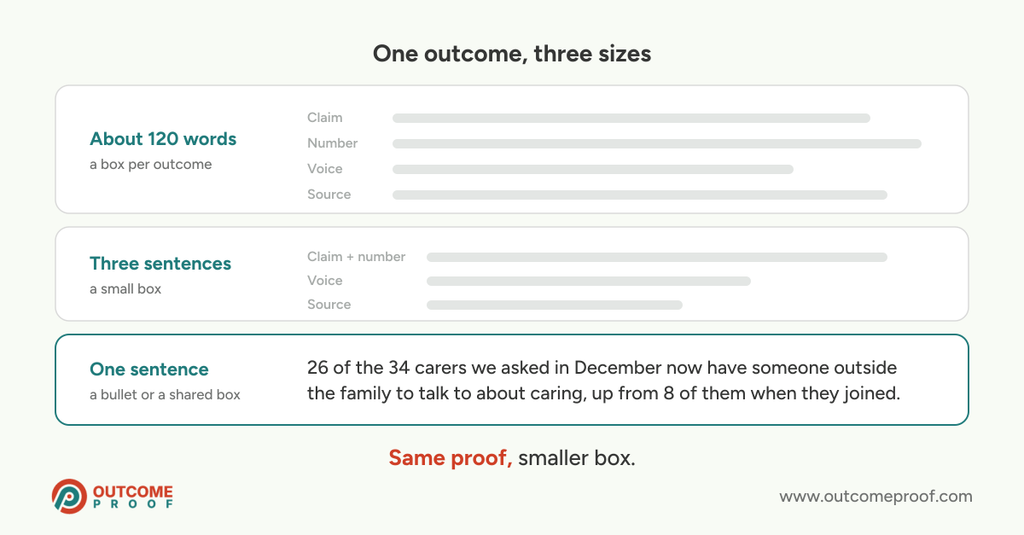
The four lines come to about 120 words. Real forms rarely give you a tidy 120-word box per outcome, so it helps to know how the lines move and shrink.
- If the form splits them up, put each line where it’s asked for. The number goes in their numbers field, the source in “how do you know”, the quote wherever they ask for people’s own words. The claim stays in the outcome box and says what the number means, without repeating it.
- In a small box, fold the number into the claim and let the timing stand in for the source: 26 of the 34 carers we asked in December now have someone outside the family to talk to about caring, up from 8 of them when they joined. One sentence, and the proof is still there.
- Where several outcomes share one box, give each its claim and number, then use one quote for the whole box.
- With character limits, check whether spaces count (they usually do); 1,000 characters is only about 160 words. Draft in a document and paste in, because online forms can time out and lose your work.
The outcome that fell short
Most years have one. In the example, the second outcome was that carers would take a break. It’s tempting to leave a shortfall out, or tuck it into a line about “ongoing challenges”, but written plainly it can do as much for your credibility as the outcomes that went to plan. The carers’ group might put it like this:
We aimed for around 20 carers to use respite vouchers from the local carers’ breaks scheme, and 4 did. When we asked why, the answer wasn’t what we’d assumed: people wanted the break, but the referral paperwork put them off, and most didn’t want to face it alone. From March we started filling in the forms with carers during the group itself, and three of the four carers who used a voucher did so after that. It’s still well short of what we hoped, so next year we’ll offer help with the forms from a carer’s first session.
Look at where the words go. The shortfall gets one plain sentence, with the real numbers and no softening. Most of the paragraph goes on the reason, which the charity found out by asking rather than guessing, and on what it changed as a result. That second half is what the funder most wants to see: that you notice when something isn’t working and do something about it. There’s no need to apologise, or to dress a small improvement up as a fix.
If you haven’t yet worked out why, say so plainly and say what you’ll try next. The same approach works for anything you delivered differently, such as a lost venue or an activity swapped for one people asked for: what changed, why, and what it meant for the people you work with.
Say how many, out of how many
One habit fixes most weak numbers: whenever you give a figure, give the total it came from.
“Most carers said they felt less alone”, on its own, asks the reader to take your word for it. “26 of the 34 we asked” gives them a figure to weigh. Likewise with attendance and referrals: 21 regulars out of 38 who ever came, rather than “strong regular attendance”.
A few more:
- Count people, not visits. When a form asks how many people you reached, it usually means different individuals. Thirty-eight carers came to the group; the attendance register adds up to far more, and mixing the two up is an easy way to overstate a year by accident.
- Separate how many you reached from how many changed. Everyone who came is your reach; the people you have evidence changed are your outcome. Some funders ask for the two as separate numbers, and some ask you to split change into “a lot”, “some” and “not yet”, which also shows who the work hasn’t helped yet.
- Don’t round up. If it was 26 of 34, write that, not “around eight in ten”.
- If your application had a target, put the actual beside it and let the reader compare, whether you passed it or not.
Before you send it
A last check, from the reader’s chair:
- Is every outcome from the application there, including the one that fell short?
- Does each claim of change have a number or a voice beside it, and a line on where it came from?
- Have you said what was hard, what you learned and what you did differently?
- Is any money spent differently from the budget explained?
- Do you have permission for every quote and photo you’ve used?
- Are the headings and word counts theirs, not yours?
- Would someone new to your charity understand what the grant paid for from the first three sentences?
If every answer is yes, send it.
Next time: what funders expect after the award
None of this is needed for the report in front of you; it’s for the next grant. It’s all written down somewhere, but spread across each funder’s own guidance pages, so charities tend to learn it one deadline at a time. The patterns from the UK funders we’ve looked at:
- Read the offer letter and the report form the day the award arrives. The letter usually says what needs permission to change, how to credit the funder and what happens to unspent money. The form shows which figures to collect along the way, such as how many different people took part, age bands or volunteer hours. If it isn’t published, ask for a copy.
- Check how often they want to hear from you. Yearly is common on grants lasting more than a year; some funders ask every six months or every quarter, some small grants need only an end-of-grant report, and a few hold a conversation instead of, or as well as, a written report. Put the dates in the diary when the grant starts.
- Take photos through the year, with the right permission. Most funders welcome photographs, and a few require them. Get consent that covers where a photo or story might appear, including the funder’s own publicity.
- Raise big changes when they happen. A venue lost, a service paused, money that won’t all be spent, or anything serious such as a safeguarding incident: funders ask to hear at the time, and a phone call then goes down far better than a surprise in December.
- Keep to the deadline. If the grant is paid in instalments, the next payment often waits for the report, and a late one can count against your next application. If you’ll be late, ask before the deadline, not after.
Where the time really goes
With the year’s notes already in order, a blank document and the structure above are all one report needs.
Arriving at the form without the material is what slows it down: a good quote nobody wrote down, the register kept by one volunteer and the survey answers by another, and a second report due three weeks later that needs the same evidence arranged differently. Most small charities reach report time like this. Each outcome section takes about a quarter of an hour when the evidence is already sitting under the right outcome, and much longer when it has to be tracked down first. That’s why capturing evidence as it happens saves more time than anything done in deadline week.
About Outcome Proof
Suppose the carers’ group used Outcome Proof. The February quote, a volunteer’s note from the autumn, the joining and December tallies and the attendance figures are captured against “carers feel less alone” as they happen, each dated, the quote with who said it and the figures with where they came from, and all of it carries through into the report. When a second funder’s report falls due, a reminder arrives beforehand and the same evidence is ready to use again. A quote or photo can’t be saved until someone confirms the person agreed. When they start a report, the team’s check-ins on each outcome are already in its section, dated. They pick the evidence, write the four lines, and copy each section into the funder’s boxes or export the whole report to Word. Whatever they gather while writing this year’s report stays filed for the next one. If they’d like help with a first draft, an optional AI feature can draft an outcome section from the evidence they select, listing exactly which items it used, and it stays switched off until they choose to turn it on.
Outcome Proof is a simple, affordable impact reporting tool designed around small charities. You can try it free for 14 days. No setup fees, no sales calls, cancel anytime.
Sources: Garfield Weston Foundation, top tips for grant reports and the Esmée Fairbairn Foundation’s reporting guidance. The carers’ group is a worked example, not a real organisation.