
If you’ve started using AI to help write funder reports, or you’re wondering whether you should, you’re in good company and you’re right to be a little wary at the same time. AI can take a genuine chore off your plate. It can also write something that reads beautifully and says nothing your funder can trust. This guide is about the line between the two: where AI genuinely helps with reporting, where it can’t help at all, and how to use it so your reports stay honest.
AI is genuinely good at this, and the sector knows it
Let’s start with the honest part. AI is very good at the writing itself. Give it some rough notes and it will turn them into clear, readable prose. It will tighten a rambling paragraph to fit a word count, suggest a structure, and recast the same content into the format a different funder wants. For a stretched team writing the same story six different ways, that is real, practical help.
The sector has already worked this out. The 2026 Charity Digital Skills Report found that around three in four small charities now use AI, and over half use it for grant fundraising. This is not a fringe habit. It is quickly becoming the normal way small charities approach the blank page.
So this guide is not going to tell you to stop. It’s going to help you use AI for the part it’s good at, without leaning on it for the part it can’t do.
The one thing AI can’t do: know what actually happened
Here is the catch, and it’s a simple one. AI writes from what you give it. If you hand it real material, the quote a parent actually said, the number of young people who actually finished the programme, the specific thing that actually changed, it will help you express that clearly. If you hand it nothing, it doesn’t stop. It fills the gap with something plausible, general and confident. The paragraph reads well. It just isn’t true, or isn’t yours.
The Charity Digital Skills Report names this worry in charities’ own words: a “loss of authentic voice” and, bluntly, “AI slop”. It also found that trust in AI has become one of the fastest-rising concerns in the sector, and that even charities actively using AI often don’t fully trust it. That instinct is sound. When it comes to reporting, the thing to be wary of isn’t the quality of the writing. It’s whether there’s anything real underneath it.
Why a funder can usually tell
Funders read a lot of reports. A programme officer might read hundreds in a season. What they’re reading for is not polish. It’s evidence that your work did what you said it would, in enough specific detail to believe.
A report full of smooth, general impact language, “beneficiaries reported increased confidence and wellbeing”, gives them nothing to hold on to. It could describe any charity, any year. The lines that land are the specific ones: the exact words a participant used, the real figure, the concrete before-and-after. Those are the parts AI can help you phrase, and the parts it cannot invent for you. Increasingly, a report that is all fluent generality reads not just as thin, but as AI-written, which is the opposite of what you want a funder feeling as they weigh your next grant.
A useful test, whether you’re prompting an AI tool or checking what it gave back: what would we see or hear if this were really happening? If the answer is in your report as a concrete, specific detail, good. If the paragraph can’t point to one, that’s the gap AI has quietly papered over.
The dividing line: gathering evidence vs writing it up
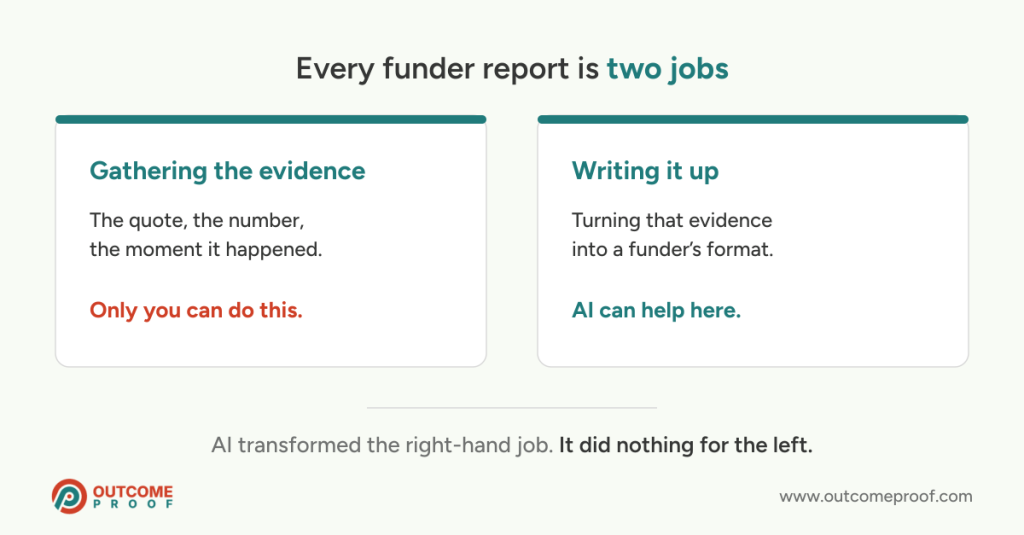
It helps to see a funder report as two separate jobs.
The first is gathering the evidence: noticing and keeping the proof of your work as it happens through the year. The quote, the survey result, the photo, the number, the small moment that showed the work landing.
The second is writing it up: turning that evidence into readable prose in whatever shape a particular funder asks for.
AI has transformed the second job. It has done nothing at all for the first. And the first is the one that makes a report trustworthy. This is why the charities who get the most out of AI are the ones who arrive at the writing with real material in hand. AI makes good evidence sing. It cannot compensate for evidence you never captured.
(If the outputs-versus-outcomes distinction is new to you, our guide to writing a good outcome covers it. And if the “same story, six formats” problem is your reality, reporting to multiple funders is the companion to this one.)
A safer way to use AI for reports
You don’t need to avoid AI to report honestly. You need to point it at the right job. Five practical habits:
- Feed it real evidence, not a blank brief. “Write a report about our youth project” invites invention. “Here are eight quotes, our attendance figures and three progress notes from this year, shape them into a 500-word section on outcome two” keeps AI doing what it’s good at: expressing your material, not manufacturing it.
- Keep a person on every fact. AI will confidently produce numbers, dates and even quotes that were never real. Check each specific claim against your actual evidence before it goes to a funder. The report’s own case-study charities were emphatic about this: they reviewed and verified everything, and treated AI as a drafting aid, not a source of truth.
- Mind what you paste in. Funder reports often contain personal, sometimes sensitive, information about the people you support. Don’t paste identifiable beneficiary details into public AI tools, and check any tool’s data terms before you rely on it. Anonymise first, and treat consent for someone’s story with the same care whether a human or an AI is doing the writing.
- Let AI do the format-shifting, not the substance. Its best trick for reporting is taking one set of real evidence and recasting it for each funder’s word count and structure. That’s the tedious part it genuinely removes, and it removes it without touching what’s true.
- Watch for the generic voice. If a paragraph could belong to any charity, that’s usually a sign AI filled a space your evidence should have. Swap it for something only your charity could say.
To check an AI draft against something, how to write a funder report sets out what each outcome section needs: a claim, a number, a voice and a source.
Should you tell your funder AI helped?
A question more charities are quietly asking, so let’s answer it directly.
The Charity Digital Skills Report asked UK grantmakers about their side of this. 13% now ask applicants to declare or informally discuss their AI use (a question about grant applications so far, rather than the reports that follow), and 12% are themselves using AI to draw insights from the monitoring reports they receive. Most funders don’t ask at all yet. But a charity reporting to several funders is now reasonably likely to meet the question somewhere, and it’s easier to have your answer ready than to be caught wondering.
The good news: if you’ve followed the habits above, the answer is short and comfortable. Something like: “AI helped with the phrasing. Every fact, number and quote comes from our own records, and a person read and approved every word before it went to you.” That covers what a funder asking the question actually wants to know: whether the substance is real, and whether a person stands behind it.
And if you’re wondering whether some rule somewhere requires you to label AI-assisted writing: reassurance rather than legal advice, but even the EU’s strict new AI transparency rules don’t require an AI label on text a person has reviewed and takes editorial responsibility for. The person reading every word is what makes the report yours.
The habit AI makes more valuable, not less
For years, the hard part of reporting was the writing: the blank page, the wrestling with words late in the evening. AI has largely solved it. To be honest about it, AI plus a tidy set of notes can draft a perfectly decent single report, and if that’s where you are, you don’t need a tool for this.
But notice where that moves the problem. When anyone can write a fluent report, the writing stops being the scarce thing. The bottleneck now is the evidence: it has to exist, it has to be real, and when a report is due it has to be findable, not scattered across one person’s inbox, three phones and a shared drive nobody’s tidied since spring. Capturing it as it happens was worth doing before AI arrived. It’s worth more now, because it’s precisely the part AI can’t fake and the part funders are learning to look for. The tool you use to write has changed. The thing that makes a report worth trusting hasn’t moved at all.
About Outcome Proof
Outcome Proof is built for the part AI leaves to you. It’s a simple tool for small charities that holds your outcomes and your evidence in one place, captured as it happens, so that when a report is due there’s something real and organised to write from. It can also help with the writing itself, if you want it to: an optional drafting feature that works only from the evidence you select, lists exactly which items it used, and says so plainly when there isn’t enough to draw on. Nothing goes into your report until you’ve read the draft and decided what to do with it. In practice it’s the habits in this guide, built in, with you as the author throughout.
Try it free for 14 days. No setup fees, no sales calls, cancel anytime.
Source and further reading: the AI-adoption figures and the sector concerns quoted here (including “loss of authentic voice” and “AI slop”) are drawn from the 2026 Charity Digital Skills Report, authored by Zoe Amar and Nissa Ramsay. Report findings correct as of its 2026 publication; check the latest edition for current figures.